Cost to study in China India or Turkey from Tanzania | EduFlare
China scholarshipsStudy abroad guidance
How Much Does It Cost to Study in China, India, or Turkey from Tanzania? A Real 2026 Budget Guide
2 Apr 20266 min readEduflare
Study in India,Turkey scholarshipsTanzania students
For most students and parents, the first real question is not, “Which country sounds exciting?” It is, “Can we actually afford this?” That is the right question to ask, because the total cost depends on the university, the course, the city, and whether a scholarship covers part of the journey.
All converted figures below are planning estimates, not payment quotes. Always confirm the exact fee on the official university or scholarship page before paying.
The good news is that China, India, and Turkey can all be realistic options for Tanzanian students. The difference is that they become affordable in different ways. India often looks lighter on monthly living costs. China often gives a strong middle ground between self-funded tuition and scholarship opportunity. Turkey can be excellent value too, but the budget changes a lot depending on city and university type.
At a glance
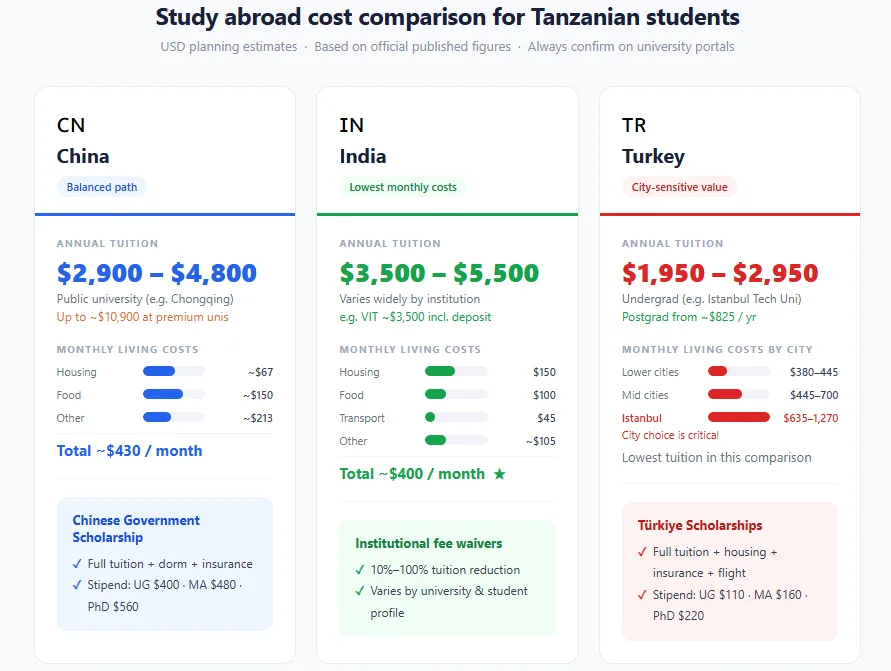
If you want the shortest answer, India usually has the lowest officially published monthly living-cost estimate in this comparison, at about $400 per month excluding tuition. China can often work well on a self-funded budget if you choose a public university in a lower-cost city, where a realistic planning figure is roughly
Article details
Written by
Eduflare
Reviewed by
EduFlare Admissions Team
Updated on
2 Apr 2026
Related articles
Keep reading
Explore more EduFlare guidance on scholarships, admissions, and studying abroad with confidence.
for basic living in the Chongqing example. Turkey can be reasonable in lower-cost cities at roughly
$380 to $445 per month
, but Istanbul can rise to around
$635 to $1,270 per month
.
USD comparison of study costs in China, India, and Turkey for International students
What it can cost to study in China from Tanzania
For China, a realistic self funded undergraduate planning range is about $2,900 to $4,800 per year for many public-university bachelor’s programs, based on Chongqing University’s published tuition bands and the USD conversion buffer. Dormitory accommodation in that example works out to roughly $800 to $1,450 per year, and small required extras like insurance, physical exam, and residence permit come to around $130, $65, and $65 respectively as planning figures.
That is why China often feels practical for Tanzanian students who choose carefully. The tuition itself may be manageable, but the real difference comes from city choice, accommodation style, and whether you are in a regular public-university program or a more premium international one.
At the higher end, not every China option is cheap. Wenzhou-Kean University’s 2026-2027 published fees translate to roughly $10,900 per year for tuition, around $1,300 to $1,600 per year for accommodation on a planning basis, and about $130 per year for insurance. That is still useful to mention in the blog, because it shows readers that “study in China” is not one single price point.
China becomes far more attractive when a student wins a major scholarship. China University of Petroleum (Beijing) says a Chinese Government Scholarship can cover full tuition, free dormitory or accommodation allowance, medical insurance, and a monthly stipend that converts to roughly $400 for undergraduates, $480 for master’s, and $560 for PhD students on this buffered planning basis.
What it can cost to study in India from Tanzania
India is the easiest country in this comparison to explain because the official Study in India portal gives a direct living-cost estimate of about $400 per month, excluding tuition. The same official breakdown places accommodation at about $150, food and housekeeping at $100, transport at $45, and smaller amounts for other student expenses.
Tuition in India is much less uniform, which is why families should not think of it as one fixed national price. Published examples show that some international programs can sit around $3,500 per year, others at $5,500 per year, and some premium private-university paths can go much higher. VIT, for example, publishes some international undergraduate programs at about $3,500 per year total including the caution deposit, while Ashoka University’s international undergraduate fee page shows substantial upfront costs even before living expenses are added.
In plain language, India often gives the lightest monthly living budget in this comparison, but that does not automatically mean the cheapest total budget in every case. A reasonably priced university in India can be excellent value. A more premium private institution may not feel cheap at all.
The scholarship model in India is also different. The official Study in India portal says institutions may offer concessions or fee waivers from 10% to 100%, depending on the institution and the student’s profile. So the smarter question is not simply “Can I study in India?” but “Which Indian university gives me the strongest total value after fee reduction?”
What it can cost to study in Turkey from Tanzania
Turkey can be very good value, but it is one of the most city-sensitive options here. For tuition, İstanbul Technical University’s published 2025–2026 international quota fees for recent-entry students translate to roughly $1,950 per year at the lower end, around $2,150 to $2,350 for several management and engineering examples, and about $2,950 per year at the upper end of the main undergraduate range once the USD conversion buffer is applied. A recent-entry postgraduate example comes to about $825 per year on the same basis.
Turkey’s monthly living cost can look very different depending on where a student lives. Bartın University estimates around €300 to €350 per month, which converts to a practical planning range of about $380 to $445 per month. Tekirdağ Namık Kemal University gives a higher example of €350 to €550 per month, which becomes roughly $445 to $700 per month with the same buffer. Istanbul Ticaret University says students in Istanbul may spend around €500 to €1,000 per month, which is roughly $635 to $1,270 per month on a planning basis.
That is why Turkey should be presented honestly in the blog. It can be affordable, especially outside the most expensive cities, but it rewards careful budgeting. A student in a lower-cost city may manage quite well. A student in Istanbul needs a more deliberate budget plan.
Türkiye Scholarships can completely change the picture. The official program says it includes tuition, accommodation, health insurance, a once-off flight ticket, and monthly stipends of 4,500 TL for undergraduates, 6,500 TL for master’s, and 9,000 TL for PhD students. Using the current exchange rate and your 10% planning buffer, those stipends work out to about $110, $160, and $220 per month respectively, on top of the major covered costs.
Costs many students forget to include
This is where families often get surprised. Tuition is not the whole budget.
An ordinary Tanzanian passport is currently listed at TZS 150,000 when applied for inside Tanzania or $90 when applied for through Tanzanian embassies abroad. On your USD planning basis, that works out to roughly $64 for an in-country application after conversion and buffer, while the abroad figure is still best planned at about $100. Students should also leave room for visa-related costs, medical checks, document preparation, travel, and a small arrival buffer for the first weeks abroad.
Which country is usually cheapest?
If the comparison is only about monthly living costs, India usually looks cheapest on the official figures used here. If the comparison is about fully funded scholarship upside, China and Turkey become much more powerful because their major scholarship programs more clearly cover tuition and key living costs. If the comparison is about a balanced self-funded path, China often sits in the middle.
So which country should you choose?
Choose India if your biggest concern is keeping your monthly spending as low as possible and you want a cost-conscious study path. Choose China if you want a strong mix of manageable public-university fees and serious scholarship upside. Choose Turkey if you want a strong international experience and you are ready to compare cities and universities very carefully before deciding.
Final word
The best question is not just, “Which country is cheapest?” It is, “Which country gives me the best fit for my budget, course, and scholarship chances?”
That question usually saves more money in the long run.
Need help comparing your real options?
If you want a country recommendation based on your grades, course, scholarship chances, and budget, book a consultation with EduFlare and get a clearer plan before you apply .